
Real-Time Policy Updates: Solving Version Control for Professional Societies
Summarize this blog with your favorite AI:
Solving Version Control for Professional Societies – TL;DR
Outdated PDFs create compliance gaps and version confusion. Associations cannot rely on emails and manual downloads. Strong document version control for professional societies requires centralized publishing. Structured real-time content updates ensure members always access the latest approved standards.
Cloud-synced platforms eliminate version chaos and administrative burden. Updates happen once and sync instantly across devices. Solutions like KITABOO enable integrated publishing, access control, and intelligent synchronization. Modern infrastructure turns publishing into a trust-building advantage.
Key Takeaways: Modern Version Control for Associations
| Challenge | Risk | Modern Solution |
|---|---|---|
| Static PDFs | Outdated standards in circulation | Centralized cloud publishing |
| Manual Updates | Delayed alignment across members | Real-time content updates |
| Version Confusion | Compliance and liability exposure | Structured document version control for professional societies |
| Access Friction | Members rely on saved files | Integrated, synced digital libraries |
If your association updates a policy today, how confident are you that every member is using the new version tomorrow?
For organizations like the American Academy of Pediatrics (AAP) and the American Bar Association (ABA), information is not optional reading. It defines standards of care, legal interpretation, and compliance requirements. When updates are delayed or missed, the consequences are serious.
Yet many societies still rely on a fragile process. Update the guideline. Upload a revised PDF. Send an email to 50,000 members and hope they replace the old file. This “publish and pray” model exposes critical gaps in document version control for professional societies.
In 2026, that approach is no longer acceptable. Associations need structured real-time content updates and a reliable single source of truth. Version control must be automatic, centralized, and verifiable.
Table of Contents
- What is the Real Cost of Outdated Information?
- What is the Modern Solution to the Version Control Chaos?
- How Does AMS Integration Strengthen Version Control?
- How to Solve the Offline Access Problem Without Losing Control?
- A Case Study: What Does Modern Version Control Look Like in Practice?
- Conclusion
- FAQs
- Summary
What is the Real Cost of Outdated Information?
What happens when your members rely on outdated guidance? The impact goes far beyond inconvenience. It affects compliance, credibility, and operational efficiency. Weak document version control for professional societies exposes your entire ecosystem to risk.
Static downloads cannot guarantee accuracy across thousands of members. Once a file is saved, control is lost. Without structured real-time content updates, outdated versions continue circulating unnoticed. That gap creates measurable consequences.
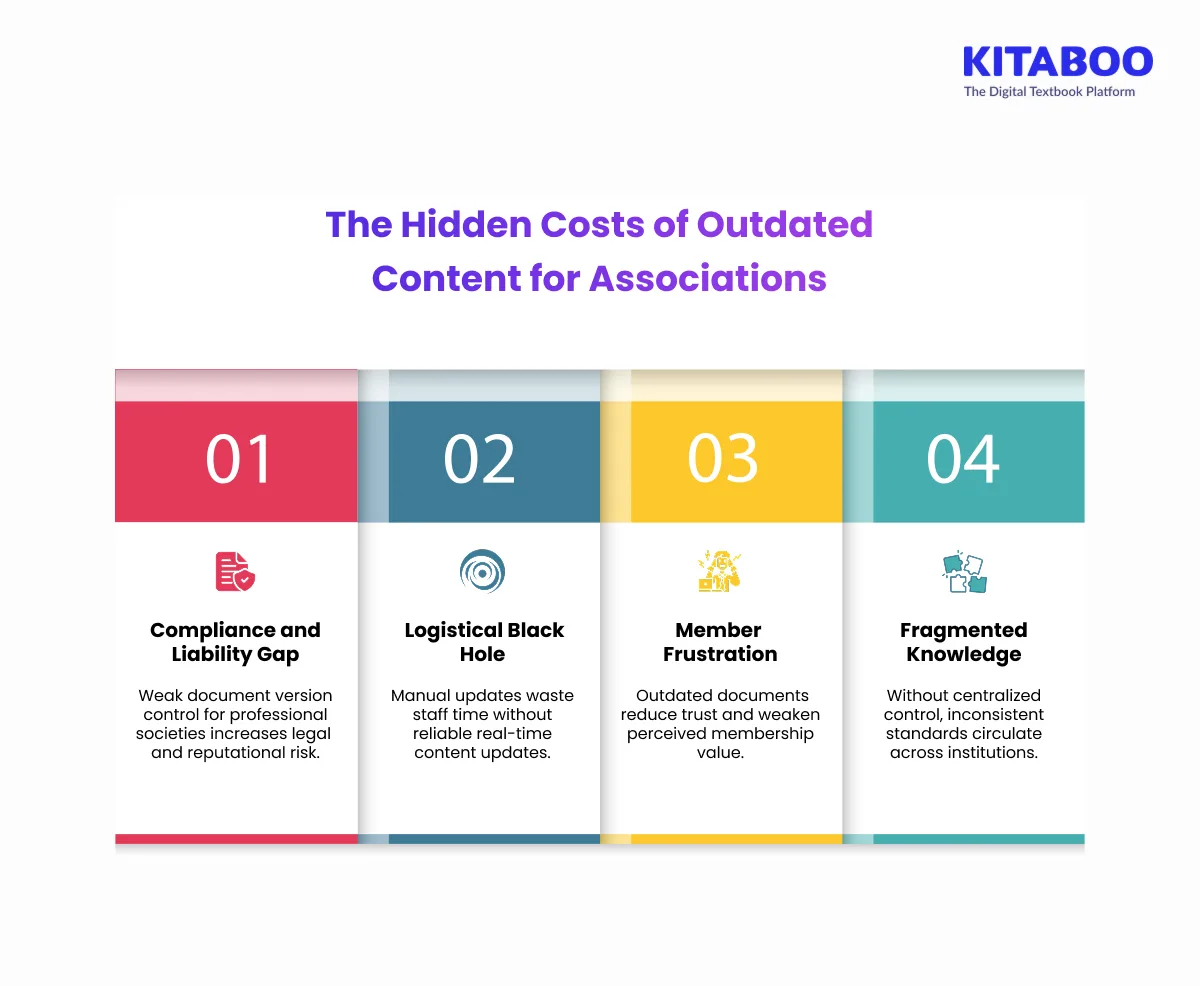
1. The Compliance and Liability Gap
For instance, consider a clinician using a 2023 protocol saved on their device. Your association issued a critical update in 2026. The clinician never downloaded the revision.
If harm occurs, serious legal questions follow. Liability may extend beyond the individual practitioner. Reputational damage can spread across the association quickly. Weak document version control for professional societies increases exposure significantly. Consistent real-time content updates reduce this compliance risk.
2. The Logistical Black Hole
Managing updates through emails and static downloads drains resources. Members repeatedly ask which version is current. Staff must confirm links and resend attachments.
This repetitive cycle consumes hundreds of hours annually. It delays higher-value strategic initiatives. Manual processes cannot scale across 50,000 members. Automated real-time content updates eliminate this inefficiency. Strong document version control for professional societies restores operational control.
3. Member Frustration
Members pay dues for reliable expertise. They expect confidence in every document they access. Discovering an obsolete file undermines that expectation.
An update email lost in spam can create confusion. Members may question the association’s reliability. This frustration will affect renewals and referrals. However, reliable real-time content updates protect member engagement and trust. Effective document version control for professional societies reinforces perceived value.
4. The Fragmented Knowledge Problem
When members download and store files locally, multiple versions begin circulating. One hospital may follow an older protocol while another references the updated standard. Over time, this creates inconsistent practices across teams and regions.
Conflicting guidance weakens your authority as the industry’s definitive voice. It also complicates audits and regulatory reviews. Weak document version control for professional societies allows this fragmentation to persist. Structured real-time content updates ensure every member works from the same verified standard.
What is the Modern Solution to the Version Control Chaos?
Static downloads were built for distribution, not governance. Once a file is downloaded, control disappears. Multiple versions begin circulating across devices and departments. This is where document version control for professional societies breaks down.
The solution is not better emails or clearer subject lines. It is centralized, cloud-based publishing. Instead of managing files, you manage one controlled master document. Modern publishing platforms like KITABOO enable structured real-time content updates within a governed ecosystem. This transforms version control from a manual task into an automated system.
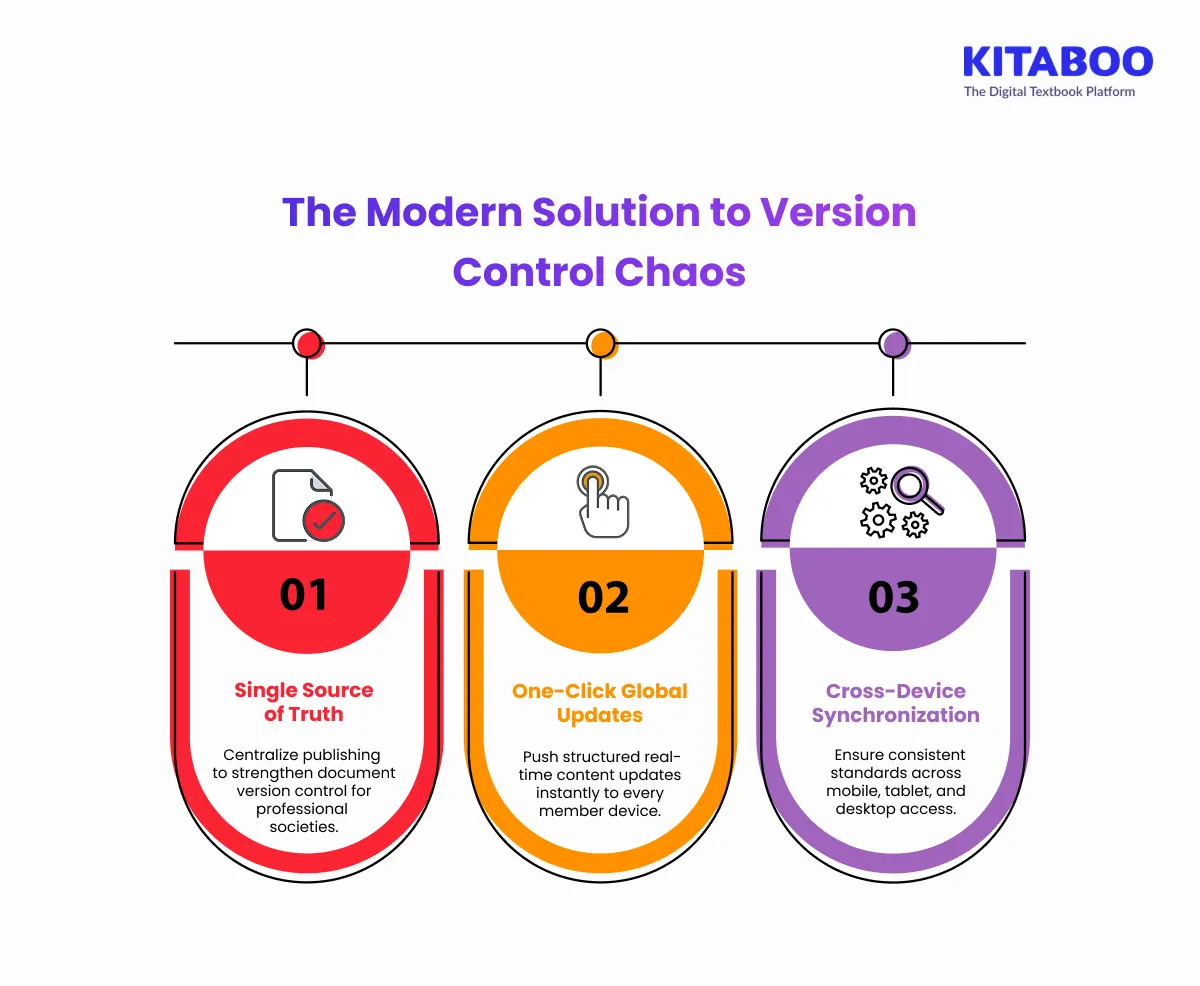
1. Establish a Single Source of Truth
A cloud-based master document eliminates duplicate versions. All edits are made in one controlled environment. Members no longer store independent files that drift out of date.
This ensures every reader references the same verified standard. Strong document version control for professional societies depends on centralization. When the source is unified, inconsistency disappears.
2. Enable One-Click Global Updates
Consider a critical update to a pediatric dosage guideline. In the past, that meant reformatting, re-uploading, and re-notifying members. The process could take days or weeks.
With structured real-time content updates, the editor updates the master file once. A single publish action pushes the revision instantly to every device. Associations using platforms like KITABOO can synchronize updates across smartphones, tablets, and desktops without manual intervention.
3. Synchronize Across All Member Devices
Members access policies and standards on different devices, at different locations like hospitals, courtrooms, and job sites. They switch between devices throughout the day. Each device must reflect the same revision to avoid confusion.
Cloud synchronization ensures alignment everywhere. No member relies on a saved file from last year. Reliable real-time content updates maintain consistency across the entire membership base.
How Does AMS Integration Strengthen Version Control?
A single source of truth only works if members can access it easily. If the latest standards live outside your core systems, adoption suffers. That is where AMS connectivity becomes essential. Integration ensures document version control for professional societies is embedded into daily workflows.
When publishing platforms connect directly with your AMS, content access becomes dynamic. Member status, committee roles, and subscription tiers can drive permissions automatically. This removes manual intervention and reduces access errors.
Modern digital publishing platforms like KITABOO integrate with leading AMS systems to support structured real-time content updates within the member ecosystem.
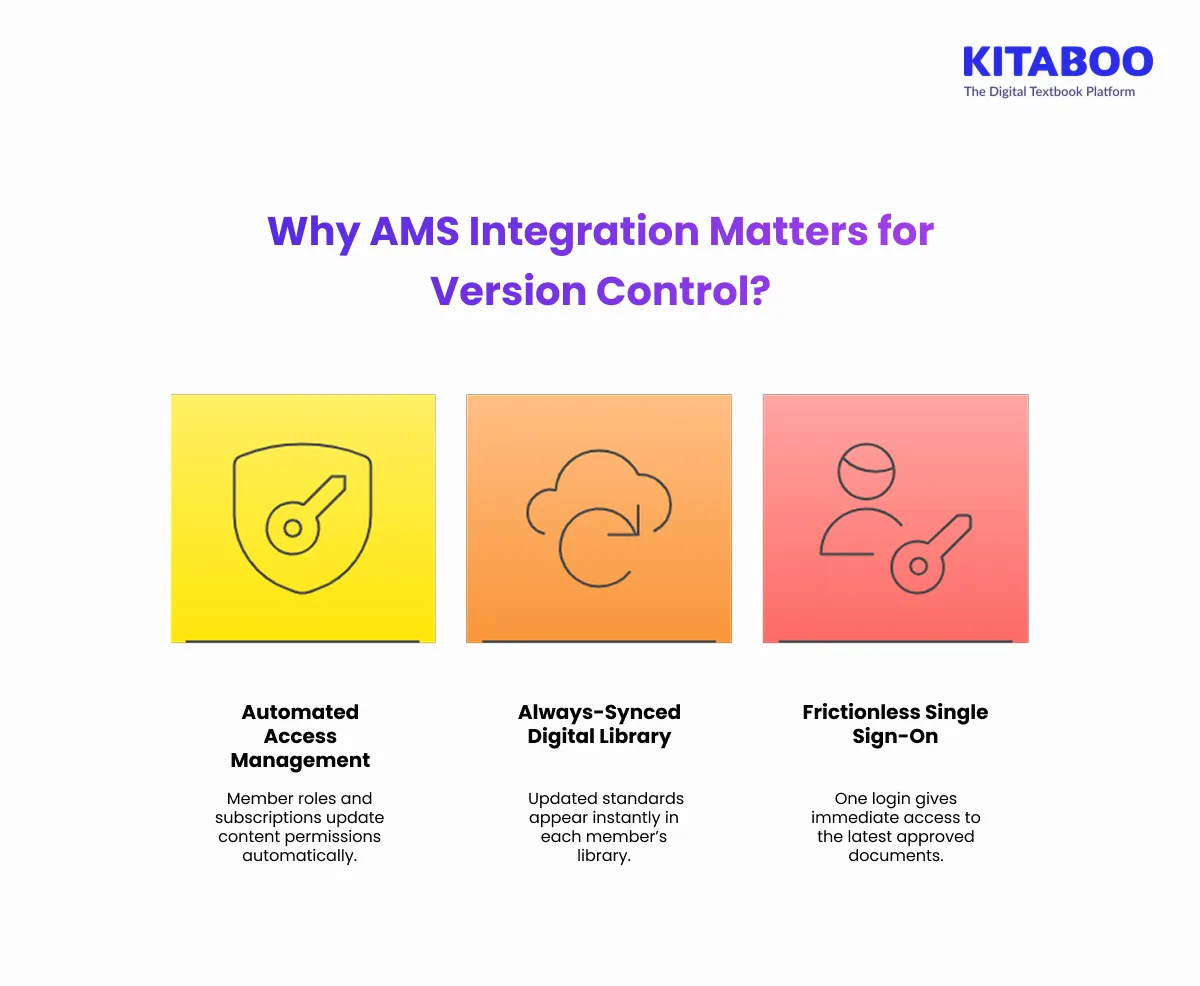
1. Automate Access Based on Member Status
Member roles change frequently. Someone may join a Legal Ethics committee or renew a premium subscription. Access to relevant standards should update automatically.
AMS integration ensures permissions adjust in real time. Updated materials appear instantly in the member’s library. This alignment supports reliable real-time content updates and accurate document version control for professional societies.
2. Eliminate Manual Permission Management
Without integration, staff must assign access manually. This creates delays and inconsistencies. Members may temporarily lose access or retain outdated permissions.
Automation reduces administrative strain and prevents errors. When systems sync correctly, governance becomes seamless. Strong integration enhances confidence in document version control for professional societies.
3. Simplify Access with Single Sign-On
Version control fails when access is complicated. If members must remember separate credentials, they avoid logging in. Friction drives them back to saved PDFs.
Single Sign-On ensures immediate entry into an updated library. The moment members log in, they see the latest standards. Integrated systems reinforce consistent real-time content updates across the membership base.

How to Solve the Offline Access Problem Without Losing Control?
PDFs became popular because they worked offline. Members could download a file and use it anywhere. That convenience felt reliable at the time. But offline PDFs never check for updates.
A saved file becomes frozen in time. It does not know when standards change. That creates hidden risk for document version control for professional societies. Associations and societies need offline access without sacrificing accuracy.
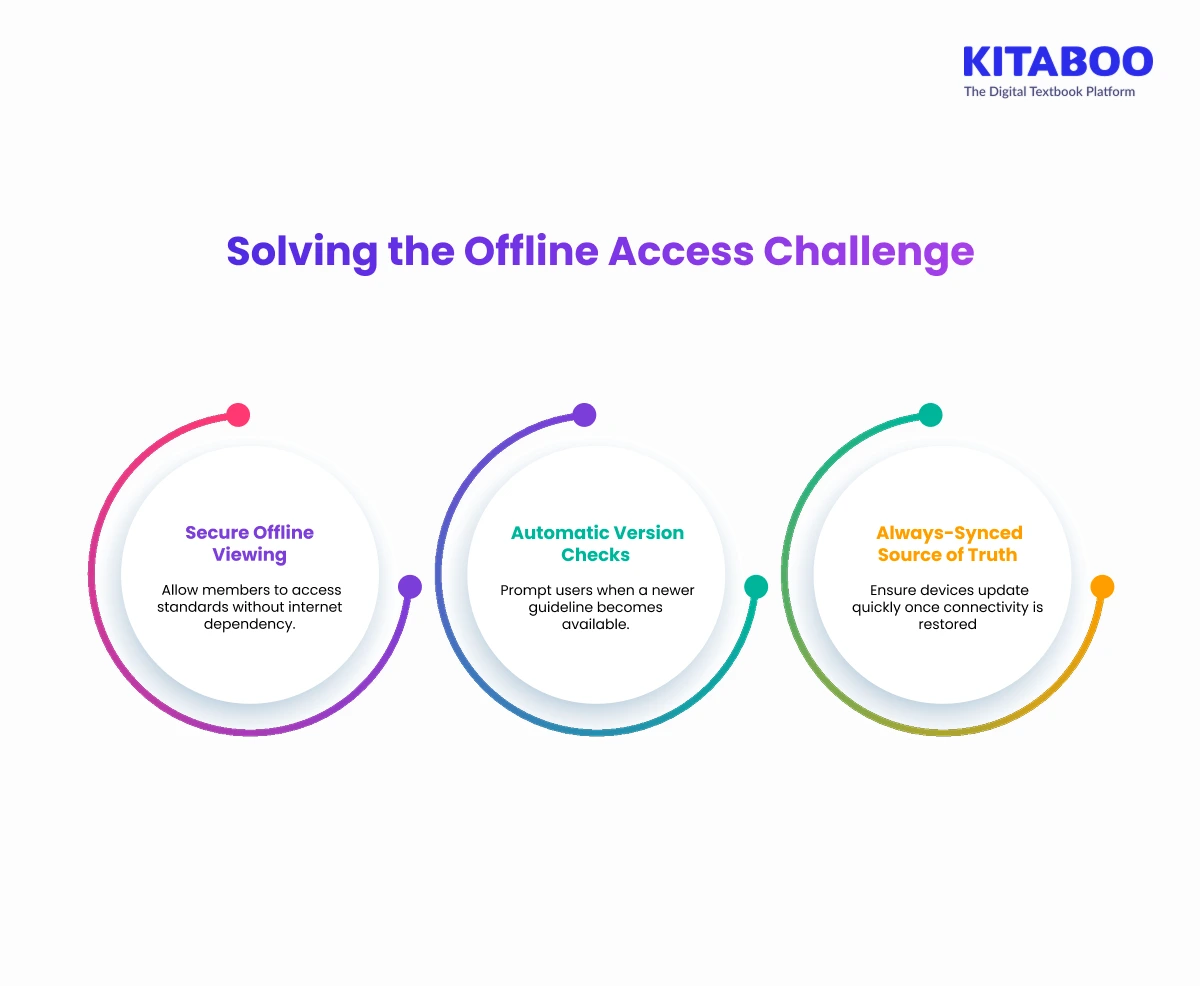
1. Enable Intelligent Offline Access
Members often work in hospitals, courtrooms, or job sites. Internet access may be inconsistent or unavailable. They still need dependable access to standards.
Modern platforms allow secure offline access within a controlled environment. Solutions like KITABOO support this without releasing static files. This balances accessibility with structured real-time content updates.
2. Trigger Automatic Version Checks
The risk begins when devices reconnect. A static PDF remains outdated indefinitely. Members may never realize a newer standard exists.
With intelligent syncing, the app performs a background version check. If a new policy is available, the member receives a prompt. This strengthens document version control for professional societies without relying on email alerts.
3. Keep the Source of Truth Continuously Aligned
Offline access should not mean permanent divergence. The moment connectivity returns, synchronization should occur. Updates should be visible and actionable immediately.
Structured real-time content updates ensure members are never far behind. Platforms such as KITABOO help associations maintain a persistent and trusted source of truth.
A Case Study: What Does Modern Version Control Look Like in Practice?
Theory matters, but implementation matters more. Let us look at how one medical society transformed its publishing model with KITABOO. This society oversees surgical safety standards where accuracy directly impacts patient outcomes. Weak document version control for professional societies was no longer acceptable.
1. The Past: Print Cycles and Static Supplements
The society printed a 400-page manual every three years. Between cycles, updates were sent as PDF supplements by email. Surgeons had to manually download and replace sections.
Over time, different versions circulated across hospitals. By year two, nearly 30 percent of the manual was outdated. Without structured real-time content updates, misalignment became inevitable.
2. The Shift: Moving to a Centralized Digital Model
The society adopted a branded digital app powered by KITABOO. Instead of distributing files, they maintained one centralized master document. All updates were made in a controlled cloud environment.
This change restored clarity and governance. Strong document version control for professional societies became part of the publishing infrastructure.
3. The Outcome: Instant and Verified Alignment
When a clinical trial required a protocol revision, the editor updated the master document on Tuesday. The change was published immediately across all devices. By Wednesday morning, every surgeon saw the revised standard.
The updated section was clearly marked with a “What’s New” annotation. Structured real-time content updates ensured everyone worked from the same verified guidance.
Conclusion
Your members do not just want access to documents. They want confidence that what they are reading is current, verified, and authoritative. Strong document version control for professional societies has become a strategic differentiator.
When you implement structured real-time content updates, publishing shifts from file distribution to trust delivery. Your association moves from reacting to version confusion to proactively governing standards.
KITABOO is the best platform for associations seeking secure, scalable, and intelligent version control. It enables centralized publishing, instant updates, AMS integration, and intelligent offline access within one ecosystem.
If you are ready to eliminate outdated documents and strengthen trust, schedule a personalized KITABOO demo today and see how modern version control should work.
FAQs
Summary
Outdated guidelines create compliance risk and operational confusion. Static PDFs cannot guarantee alignment across thousands of members. Weak document version control for professional societies exposes reputational and legal vulnerabilities. Associations need centralized control instead of manual distribution.
Cloud-based publishing replaces scattered downloads with one master source. Structured real-time content updates ensure instant synchronization across devices. Members always access the latest approved standard. This eliminates version confusion and administrative burden.
Integrated systems further strengthen governance and access control. Offline intelligence ensures accuracy even in low-connectivity environments. Platforms like KITABOO enable scalable, secure, and reliable publishing infrastructure. The result is stronger trust, reduced risk, and operational clarity.
Discover how a mobile-first training platform can help your organization.
KITABOO is a cloud-based platform to create, deliver & track mobile-first interactive training content.