
Mobile-First Certification: Training Association Members Where They Live
Summarize this blog with your favorite AI:
Mobile-First Certification: Training Association Members Where They Live – TL;DR
Professionals no longer complete certifications in long desktop sessions. Their learning happens in short, mobile-driven moments. Associations must modernize delivery through mobile-first certification to stay competitive. Flexible access improves engagement and completion rates across association training programs.
Branded apps, offline capability, micro-learning design, and seamless LMS integration make mobile-first learning practical and measurable. Platforms like KITABOO enable this transition within a fully integrated ecosystem. When training fits into daily routines, members progress consistently and programs gain long-term value.
Certification challenges at a glance:
| Challenge | Traditional Model | Mobile-First Approach |
|---|---|---|
| Limited Time | Long desktop sessions | Short, flexible learning windows |
| Connectivity Gaps | Browser-only access | Offline study with auto-sync |
| Low Completion | Interrupted progress | Micro-learning with visible progress |
| Data Tracking | Manual or delayed updates | Seamless LMS/AMS integration |
When was the last time your members had three uninterrupted hours to spare? The real challenge in 2026 is not lack of learning material, it’s the scarcity of time. Professionals no longer sit at desks waiting to learn and complete certification courses.
Your members are clinicians between patient rounds. They are lawyers commuting on crowded trains. They are engineers working on active sites. Their learning happens in-between work. That is why mobile-first learning is essential.
If your association’s Continuing Education Units (CEUs) live inside a desktop-only portal, access becomes a barrier. Members postpone courses until they “find time.” Many never return to complete them. Outdated delivery models weaken your association training programs and reduce engagement.
To stay relevant, associations must rethink delivery, not just curriculum. A true mobile-first certification model meets members where they already are. It turns spare minutes into measurable progress. It keeps your programs competitive in a mobile-driven world.
Table of Contents
- Why Are Desk-Bound Certification Completion Rates Stalling in a Mobile-First World?
- How Can a Branded App Strengthen Mobile-First Certification?
- How Can Offline Learning Strengthen Mobile-First Certification?
- How Does Micro-Learning Improve Mobile-First Certification?
- How Does Seamless CEU Tracking Strengthen Mobile-First Certification?
- Conclusion
- FAQs
- Summary
Why Are Desk-Bound Certification Completion Rates Stalling in a Mobile-First World?
If your members are not completing certifications, the problem may not be the curriculum. It is the delivery environment. Many LMS platforms were designed for a desk-based routine that no longer exists. Without mobile-first learning, even strong association training programs struggle to keep pace with real life.
1. The Learning and Workday Gap
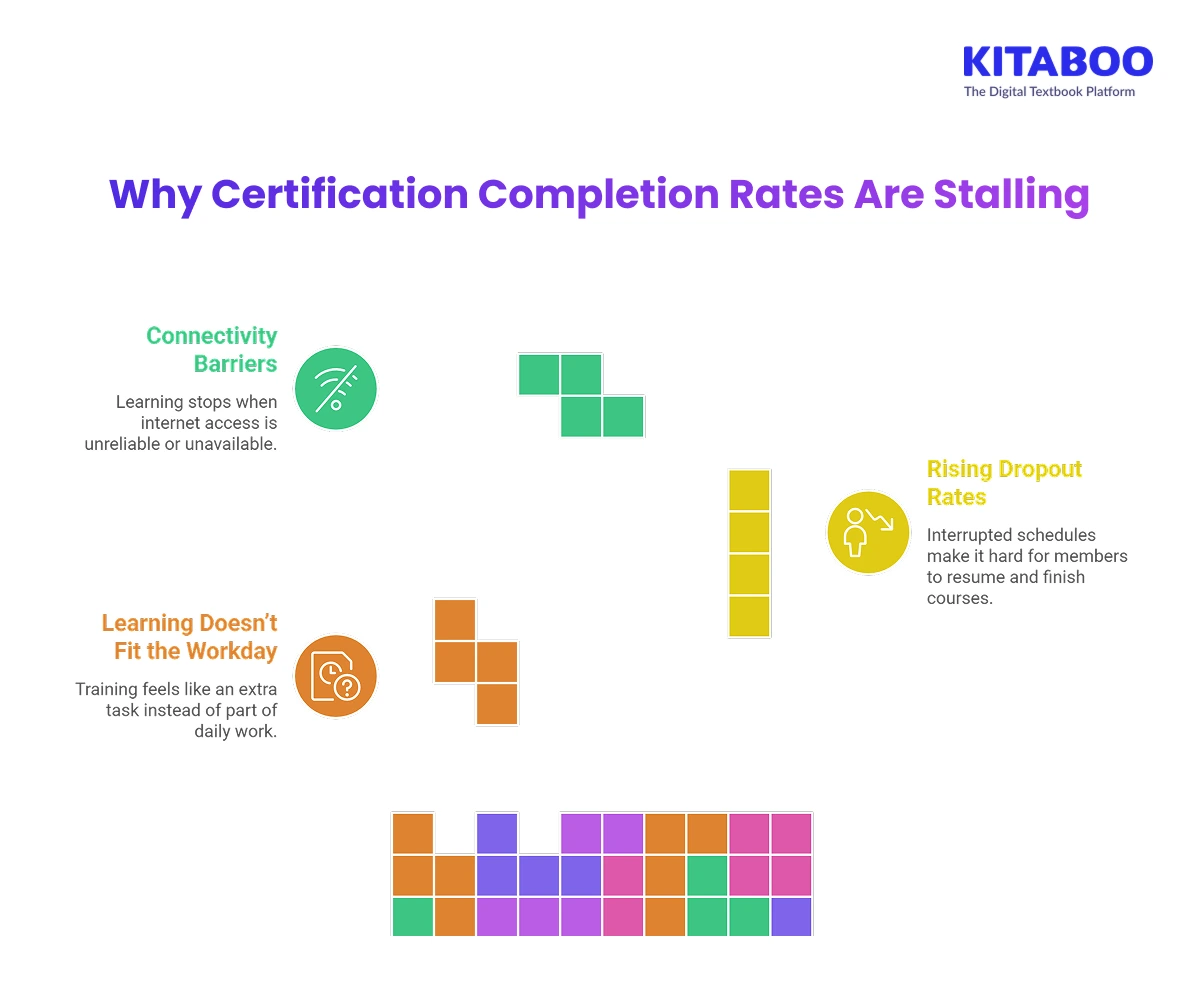
Most professionals don’t separate “work time” and “learning time” anymore. Their day is fragmented across meetings, travel, and urgent tasks. When certification requires a dedicated desktop session, it feels like an additional burden.
As a result, learning becomes something they postpone. They wait for the “right time” that rarely arrives. A true mobile-first certification model removes that barrier by fitting into short, natural breaks. When training aligns with daily rhythm, engagement becomes consistent rather than forced.
2. High Dropout Rates
Members often begin a course with genuine motivation. They complete the first module and intend to continue soon. Then schedules shift, deadlines appear, and priorities change.
If access requires returning to a desktop portal, the restart feels inconvenient. The longer the pause, the harder it is to resume. Without flexible mobile-first learning, momentum fades quickly. Over time, dropout rates quietly increase across your association training programs.
3. Connectivity Anxiety
Traveling professionals frequently have time to study. They sit on planes, trains, or in waiting rooms with unexpected free minutes. Yet browser-based systems demand stable Wi-Fi.
When connectivity fails, progress stops. That interruption breaks progress, focus and motivation. A strong mobile-first certification approach must support modern work patterns, including offline access. Continuous mobile-first learning ensures progress does not depend on network strength.
How Can a Branded App Strengthen Mobile-First Certification?
If learning happens on phones, your association must live there too. A mobile browser link is not enough. Presence begins with visibility and identity. A branded app places your association on the member’s home screen.
This signals commitment to mobile-first certification. It shows your programs are designed for real life, not just desktops. Strong association training programs must meet members where they already spend time. A branded app drives impact in three critical ways.
1. Own a Permanent Space in the Member’s Day
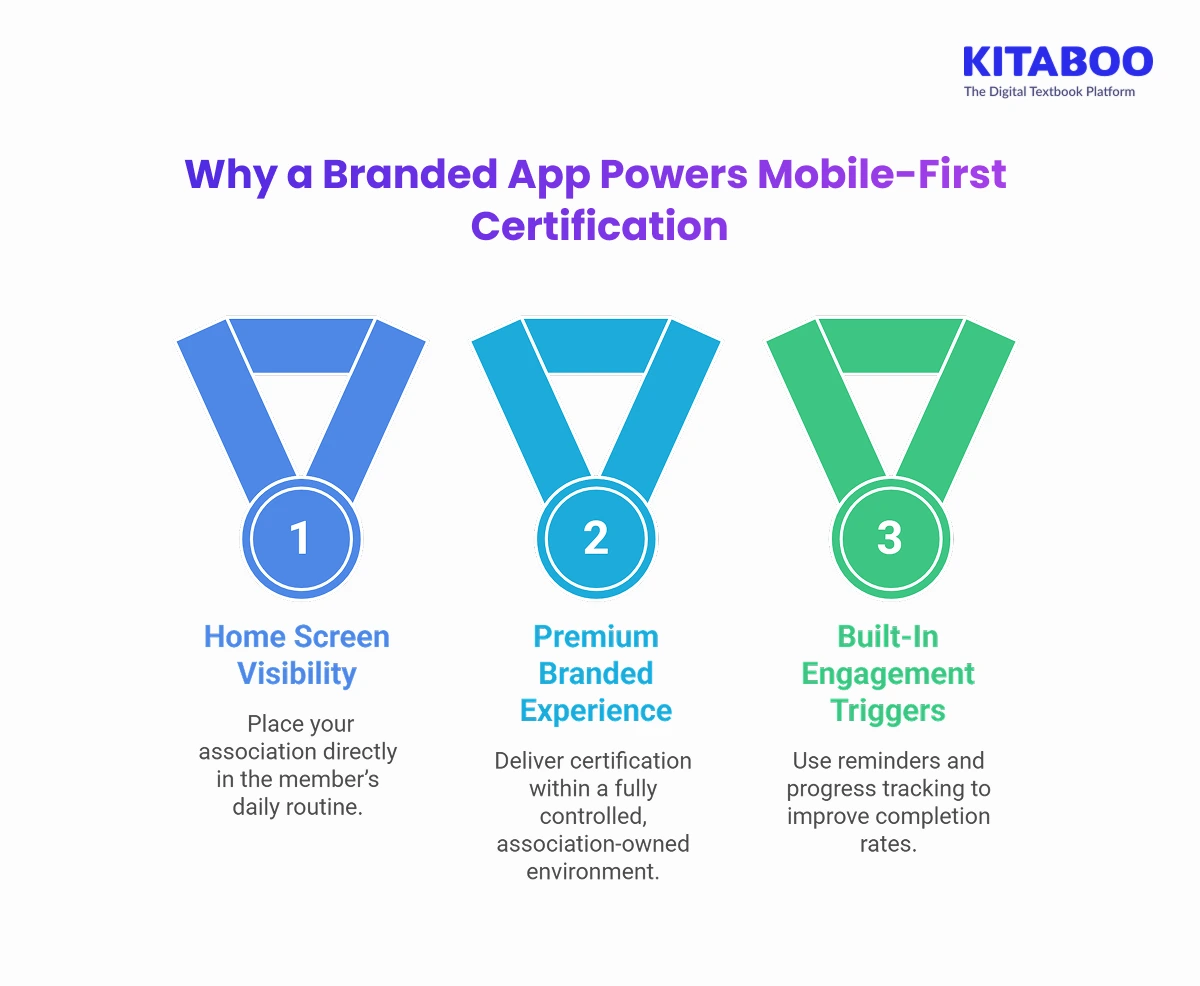
A white-label app keeps your association visible every day. Members unlock their phones constantly throughout the day. Seeing your brand reinforces relevance and authority. That repeated exposure strengthens recall and connection.
When learning is one tap away, hesitation decreases. Members do not search for portals or forgotten passwords. This convenience supports consistent mobile-first learning across fragmented schedules. Accessibility drives higher participation over time.
2. Deliver a Premium, Association-Owned Experience
Members should feel immersed in your ecosystem, not a generic platform. A fully branded interface reflects your standards and professionalism. It reinforces that certifications are issued by your authority. This strengthens credibility across your industry.
Solutions like KITABOO’s white-label platform allow full brand alignment. The experience feels cohesive from login to certificate download. That polish increases perceived value of your mobile-first certification offerings. Elevated experience leads to stronger engagement with your association training programs.
3. Turn Visibility into Ongoing Engagement
A branded eBook reader app enables structured notifications and reminders. Members receive prompts to resume unfinished modules. These nudges reduce drop-offs and maintain momentum. Engagement becomes proactive rather than reactive.
Progress tracking inside the app builds motivation. Members see advancement toward completion in real time. This supports steady mobile-first learning instead of sporadic desktop sessions. Over time, that consistency improves retention and certification completion rates.

How Can Offline Learning Strengthen Mobile-First Certification?
Your members do not stop learning when internet access drops. They work in hospitals, courtrooms, airports, and construction sites. If training depends on constant connectivity, progress becomes fragile. A strong mobile-first certification model must function in real-world conditions.
Offline capability is essential for modern professionals. Without it, learning pauses at the worst moments. Reliable access strengthens participation and continuity. That reliability defines effective association training programs and practical mobile-first learning.
Here’s how offline access and auto-sync protect engagement and data accuracy.
1. Enable Full Offline Study Without Disruption
Professionals often find valuable study time while traveling. A long commute or flight creates focused learning moments. Yet browser-based systems stop working without Wi-Fi. That interruption breaks momentum and focus.
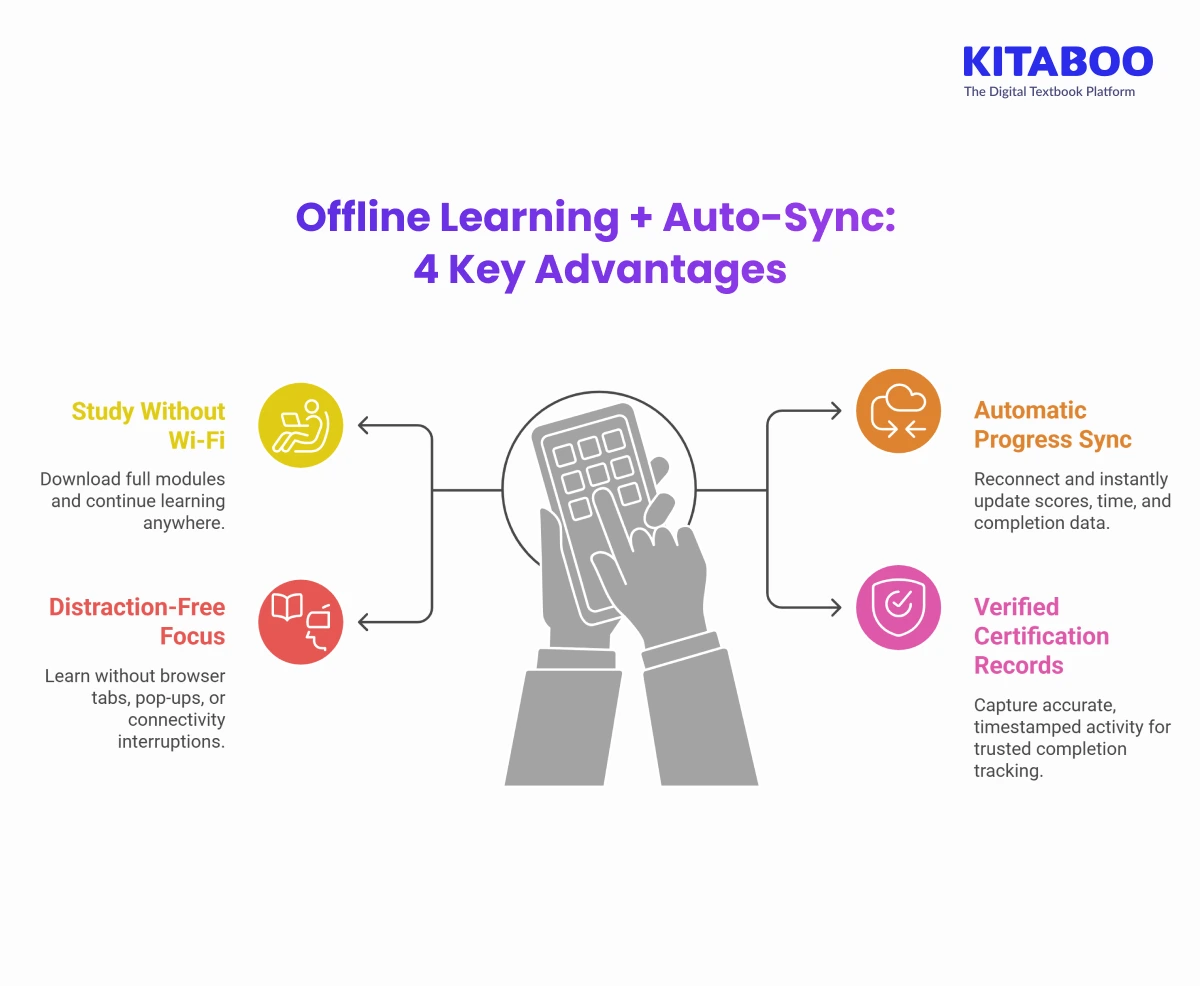
Offline-enabled platforms like KITABOO allow full modules to download locally. Members can read interactive content, watch videos, and complete quizzes offline. This ensures mobile-first learning fits real schedules without interruption. Progress continues even in connectivity gaps.
2. Automatically Sync Progress Back to Your Systems
Offline access must not create reporting gaps. Certification data must return accurately to your LMS or AMS. Without synchronization, administrators lose visibility and control. Lack of LMS or AMS integration weakens confidence in your mobile-first certification model.
When the device reconnects, progress syncs automatically in the background. Quiz scores, time spent, and module completion data update instantly. This protects the integrity of your association training programs. Members experience flexibility while your systems maintain accuracy.
3. Create Focused, Distraction-Free Learning Moments
Offline study reduces digital distractions. There are no browser tabs, notifications, or unstable connections. Members can focus fully on the material.
This improves comprehension and retention. Learning becomes intentional instead of fragmented. A strong mobile-first certification experience should support deep focus, not just access. That is how mobile-first learning strengthens real outcomes in your association training programs.
4. Preserve Certification Integrity and Audit Readiness
Certification programs must withstand scrutiny. Administrators need reliable proof of completion and engagement. Offline activity should never create uncertainty in reporting. Accuracy builds institutional trust. Structured syncing ensures all learner actions are captured and timestamped.
There are no manual uploads or unverifiable claims. This protects the credibility of your mobile-first certification system. Strong data integrity strengthens long-term confidence in your association training programs and scalable mobile-first learning delivery.
How Does Micro-Learning Improve Mobile-First Certification?
Mobile-first is not only about smaller screens. It is about smarter content design. Long certification manuals overwhelm busy professionals. Effective mobile-first learning breaks content into focused, manageable segments.
Modern members prefer progress in short bursts. They study between meetings or during short breaks. Strong association training programs must respect limited attention spans. That is where structured mobile-first certification models evolve.
Here’s how micro-learning transforms engagement and completion.
1. Break Large Manuals into Manageable Segments
A 100-page manual feels intimidating on any device. Members delay starting because the workload feels heavy. Smaller segments remove that mental barrier.
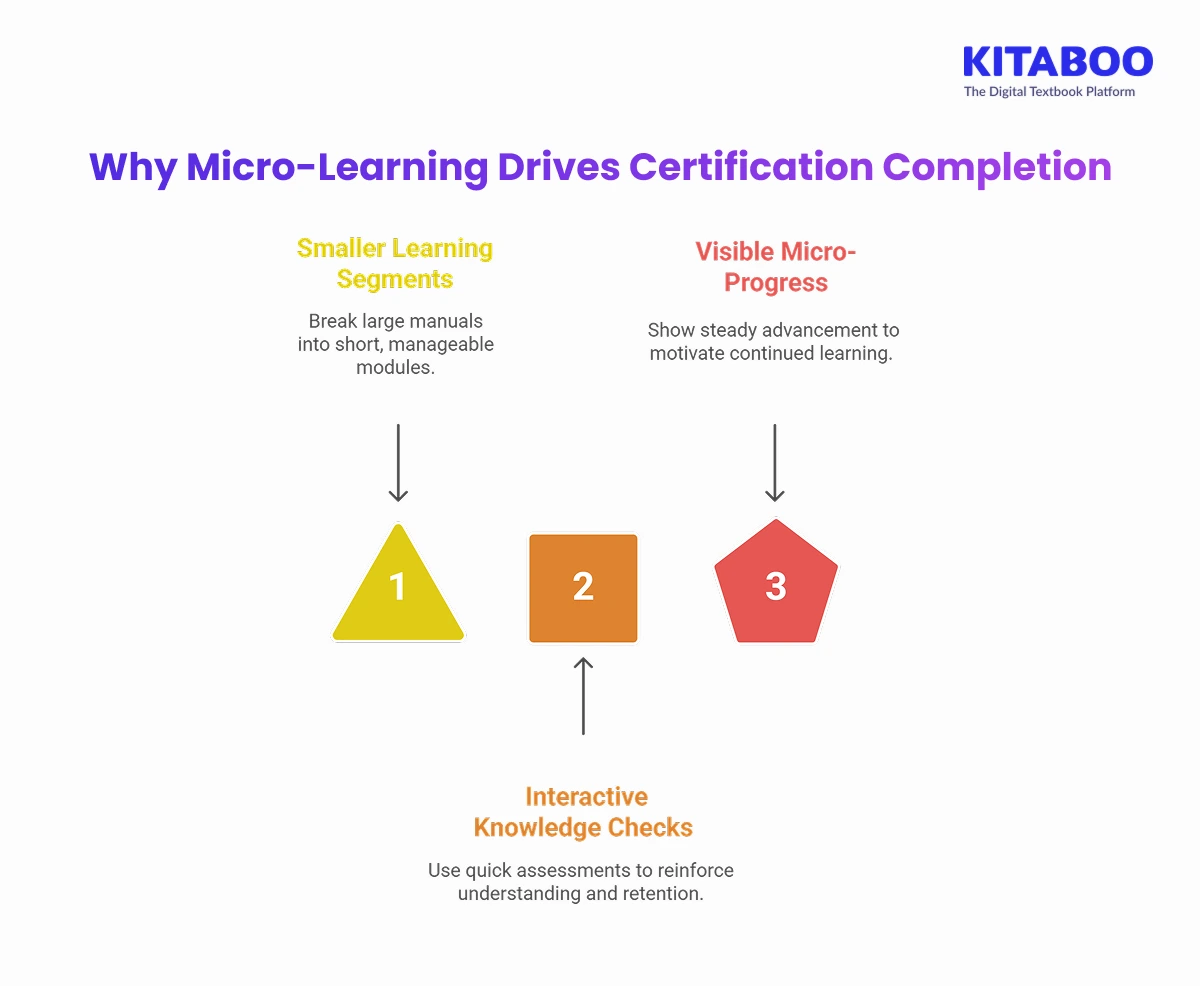
Dividing content into short, focused modules makes progress visible. Each section feels achievable within minutes. This structure supports steady mobile-first learning across fragmented schedules. Small wins drive consistent engagement.
2. Insert Interactive Checkpoints for Continuous Engagement
Passive scrolling reduces retention. Members need interaction to stay focused. Short knowledge checks reinforce understanding immediately. Using tools like KITABOO’s interactive widgets, associations can insert quick assessments within modules.
A one-question checkpoint every few pages keeps attention active. This approach strengthens mobile-first certification outcomes and improves performance in association training programs.
3. Reward Micro-Progress to Build Momentum
Completion should feel continuous, not distant. Micro-progress indicators show advancement after every small task. Members feel encouraged to continue.
Tracking small achievements builds motivation over time. Even a five-minute session produces measurable results. Structured mobile-first learning turns short study windows into meaningful certification progress.
How Does Seamless CEU Tracking Strengthen Mobile-First Certification?
Certification?
Mobile learning must connect directly to your core systems. If progress stays inside an app, reporting breaks down. That creates data silos and administrative confusion. Strong mobile-first certification depends on seamless integration.
Members should not think about tracking. Administrators should not chase completion data. Well-designed association training programs ensure progress flows automatically between systems. That is how mobile-first learning remains both flexible and measurable.
Here’s how seamless Continuing Education Units (CEU) tracking delivers real value.

1. Eliminate Data Silos Across Platforms
When learning operates separately from your system, reporting gaps appear. Administrators cannot verify who completed which modules. Manual reconciliation becomes time-consuming and error-prone.
Deep LMS and AMS integration with your eBook publishing platform removes this friction. Mobile activity syncs directly into central records. This ensures your mobile-first certification system maintains full transparency and accuracy across all association training programs.
2. Enable Instant Certification Upon Completion
Members expect immediate recognition after finishing a course. Delays in certificate generation reduce satisfaction. Manual processing slows momentum and creates support requests.
With seamless integration, certificates trigger automatically once modules sync. The experience feels immediate and professional. This reinforces the value of mobile-first learning and strengthens trust in your association training programs.
3. Unlock Behavioral Insights for Smarter Program Design
Data should guide future content strategy. Administrators need visibility into module popularity and completion patterns. Without analytics, improvements rely on guesswork.
Integrated systems provide detailed engagement metrics across devices. Associations can identify which modules drive results. These insights help refine mobile-first certification offerings and improve long-term association training programs.
Conclusion
Your members are not desk-bound anymore. Their learning happens between meetings, during travel, and in short daily breaks. If your programs do not adapt, engagement will decline. Mobile-first certification is no longer optional.
When training fits into real life, completion improves naturally. Offline access, micro-learning, branded apps, and seamless tracking create momentum. Strong mobile-first learning strengthens outcomes across your association training programs. Flexibility and structure must work together.
KITABOO is the best platform for associations building scalable, integrated mobile certification experiences. It combines branded apps, offline capability, LMS integration, and analytics in one ecosystem. If you are ready to modernize your certification strategy, schedule a personalized demo today.
FAQs
Summary
Professionals no longer learn at desks for hours. Their development happens in short, in-between moments. Associations must adapt their association training programs to match this reality. A strong mobile-first certification model meets members where they already are.
Branded apps, offline access, micro-learning, and seamless CEU tracking drive completion and engagement. Structured mobile-first learning removes friction and improves consistency. When training fits naturally into daily routines, outcomes improve. Associations that modernize delivery will retain members and strengthen long-term program value.
Mobile-first certification is a strategic shift in how associations deliver professional growth. When learning is flexible, branded, and fully integrated, it becomes part of daily work life. That transformation strengthens participation, satisfaction, and long-term loyalty.
Discover how a mobile-first training platform can help your organization.
KITABOO is a cloud-based platform to create, deliver & track mobile-first interactive training content.