Adoption Intelligence
Real-time visibility into active and upcoming science and STEM instructional materials adoptions across U.S. states.
More states added regularly. Speak to our team about your specific adoption targets.
KITABOO tracks science and STEM instructional materials adoptions across all 50 states — NGSS and TEKS submission deadlines, approved list dates, and review windows, filtered to the states your catalog targets.
Five questions. Two minutes. A readiness score and gap analysis, before your evaluator asks first.



How is your science content currently structured for digital delivery?
Real results from curriculum publishers delivering science and STEM
content at scale.
The Science Publisher's Digital Readiness Checklist — what evaluators actually look for in a digital science program, including NGSS alignment, lab content requirements, and multimedia standards. One page, no fluff.
If what you have read maps to where your program is right now, a 30-minute conversation is probably worth your time.
Not a feature list. A look at how science publishing teams use the
platform day to day.
🔬
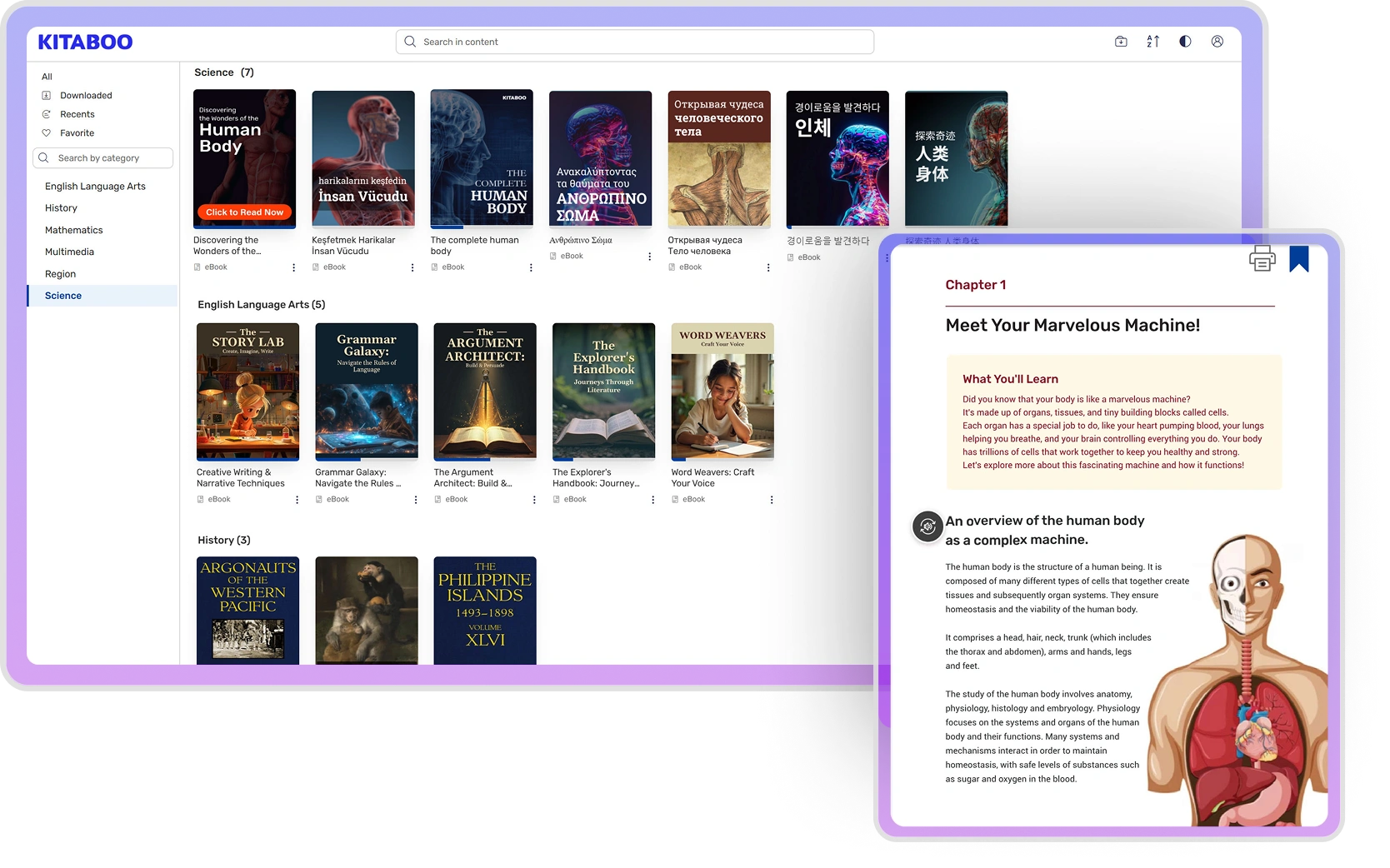
Publishers layer interactive markup onto science illustrations — hotspots on a plant cell cross-section, labeled regions on a circuit diagram, annotated anatomy visuals. Students tap to explore, not just look at a flat image.
🎬
Publishers embed instructional video directly inside the content — not as an external link. A chapter on the circulatory system includes the animation right after the explanation. A chemistry lesson shows the reaction in motion, then moves into the concept check.
🧪
Digital lab preparation ensures students arrive ready — reducing errors, improving safety, and maximizing hands-on time. Pre-lab activities, safety guidelines, and experiment procedures are embedded and assignable. Teachers track completion before students enter the lab.
📖
Pre-built glossary markers — definitions appear inline when students tap a term like "exothermic" or "tectonic subduction," without leaving the page. Highlight any word to translate or define on the spot. Multilingual content delivery for diverse classrooms.
♿
TTS built in — essential for science vocabulary and impaired readers. Immersive reading modes with font, spacing, and contrast controls. WCAG 2.2 Level AA compliant structure. JAWS/NVDA support, keyboard navigation, and read-aloud features out of the box.
📊
Usage analytics across science-specific interactions — time on task, diagram engagement, video completion, quiz performance, lab prep completion rates. The difference between knowing your content is delivered and knowing it is being used.
If what you have read maps to where your program is right now, a 30-minute conversation is probably worth your time.
AI-Powered Learning Assistant
K.AI sits inside your authoring workflow and helps editorial teams generate supplementary science content — summaries, questions, flashcards — directly from your existing material.
Auto-generate multiple question types aligned to concepts.
Create summaries and learning objectives.
Extract key concepts automatically.
Publishers need infrastructure that is proven and deployable — not a science program prototype assembled under deadline pressure.
Go from manuscript to interactive digital science program in weeks, not months. Tappable diagrams, embedded video, lab prep content, and glossary tools — ready before the submission window closes.
Deliver the same quality experience whether an institution uses Canvas, Schoology, or direct web access. Evaluators see the same interactive program — diagrams, video, and lab materials — everywhere.
Show evaluators a polished, fully interactive science program — tappable cell diagrams, inline experiment videos, assignable lab prep — not a static prototype or a slide deck.
No pitch deck. No pressure. Just a conversation about what your program needs digitally — and whether KITABOO is the right fit.